Luxury Residential vs. Commercial Investment in DFW Mid-Cities
Compare the financial returns and lifestyle benefits of residential properties versus commercial real estate across Fort Worth, Arlington, Mansfield, and surrounding communities.

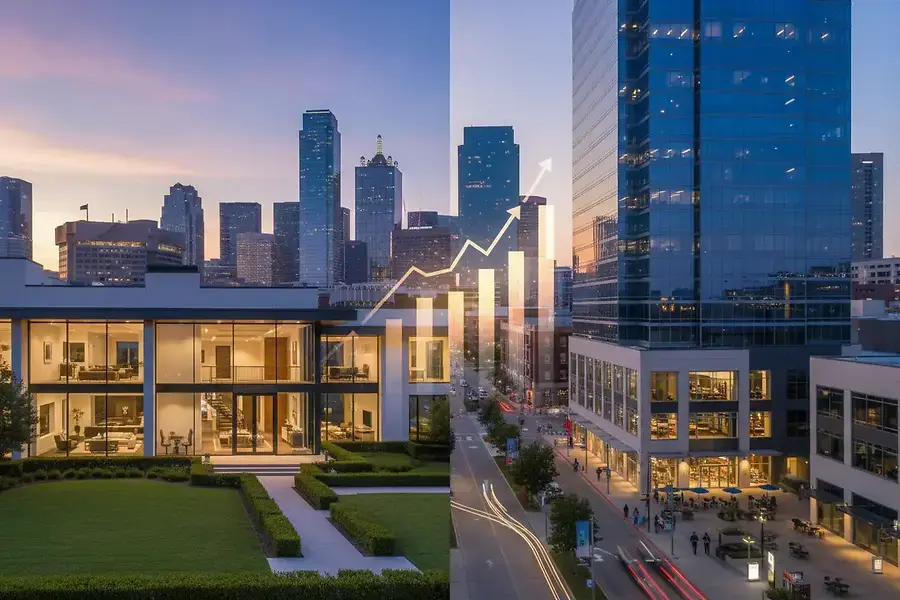
Understanding the Residential Real Estate Market in DFW Mid-Cities
The DFW Mid-Cities region, encompassing Fort Worth, Arlington, Mansfield, and surrounding communities, has emerged as one of Texas's most dynamic residential real estate markets. This area offers a unique blend of urban convenience and suburban charm, making it increasingly attractive to both homeowners and investors seeking luxury properties.
Market Growth and Demographics
The residential market in the Mid-Cities has experienced consistent growth driven by population expansion, corporate relocations, and improved infrastructure. Young professionals, families, and retirees are drawn to the region's excellent schools, diverse employment opportunities, and vibrant community amenities. This demographic shift has created strong demand for luxury residential properties, particularly in master-planned communities and established neighborhoods.
Luxury Residential Investment Benefits
- Lifestyle Integration: Luxury residential properties offer personal enjoyment alongside investment returns, allowing owners to live in their investment
- Steady Appreciation: Premium properties in desirable Mid-Cities locations typically appreciate at 4-6% annually
- Rental Income Potential: High-end properties attract affluent tenants willing to pay premium rents, often generating 5-7% annual rental yields
- Tax Benefits: Mortgage interest deductions and depreciation allowances provide significant tax advantages
- Lower Vacancy Rates: Luxury properties in sought-after areas maintain higher occupancy rates compared to standard residential units
Commercial Property Investment Opportunities and Market Trends
The commercial real estate sector in the DFW Mid-Cities presents compelling opportunities for investors seeking higher income potential and portfolio diversification. The region's strategic location, robust business environment, and growing corporate presence have positioned it as a prime commercial investment destination.
Commercial Real Estate Categories
Commercial investments in the Mid-Cities span multiple property types, each with distinct advantages:
- Office Space: Corporate headquarters and professional offices continue to attract businesses seeking proximity to major employment centers
- Retail Properties: Shopping centers and standalone retail locations benefit from the region's growing consumer base
- Industrial Facilities: Warehouses and distribution centers thrive due to excellent transportation infrastructure and logistics positioning
- Mixed-Use Developments: Properties combining residential, retail, and office spaces offer diversified income streams
Market Trends and Opportunities
The commercial market is experiencing significant transformation driven by e-commerce growth, flexible work arrangements, and evolving consumer preferences. Investors who understand these trends can capitalize on emerging opportunities. Industrial properties, particularly those supporting last-mile delivery networks, continue to command strong demand and premium valuations. Additionally, mixed-use developments that blend residential and commercial spaces are gaining traction as communities seek walkable, integrated environments.
Comparing ROI, Rental Income, and Appreciation Potential
Return on Investment Analysis
When evaluating investment performance, several key metrics deserve careful consideration:
Residential properties typically offer moderate but stable returns, with appreciation ranging from 4-6% annually and rental yields between 5-7%. Commercial properties can deliver higher yields, often ranging from 7-12% annually, though they may experience greater volatility and require more active management.
Rental Income Comparison
Residential luxury properties generate consistent monthly income from tenant payments, with minimal management requirements in many cases. Commercial properties often command higher absolute rental rates, but may involve longer lease negotiations, more complex tenant relationships, and greater tenant turnover risks. The key difference lies in income stability versus income potential—residential offers predictability, while commercial offers higher earning capacity.
Long-Term Appreciation
Both property types appreciate over time, but through different mechanisms. Residential properties benefit from population growth, neighborhood development, and lifestyle demand. Commercial properties appreciate based on business fundamentals, location desirability, and income-generating capacity. In the DFW Mid-Cities, both sectors show strong appreciation potential, with commercial properties potentially outpacing residential in high-growth corridors.
Making Your Investment Decision Based on Financial Goals and Lifestyle
Assessing Your Investment Profile
The choice between residential and commercial investment depends on your unique circumstances. Consider these critical factors:
- Time Commitment: Residential properties require less active management; commercial properties demand more hands-on oversight
- Capital Requirements: Commercial properties typically require larger initial investments and stronger financing qualifications
- Risk Tolerance: Residential offers stability; commercial offers higher returns with increased volatility
- Lifestyle Preferences: Residential allows personal use and enjoyment; commercial is purely investment-focused
- Exit Strategy: Residential properties have broader buyer pools; commercial sales require specialized investors
Hybrid Investment Approach
Many sophisticated investors in the DFW Mid-Cities pursue a balanced portfolio approach, combining both residential and commercial properties. This strategy leverages the stability of residential investments with the income potential of commercial properties, creating diversification and reducing overall portfolio risk.
Final Recommendations
Choose residential luxury properties if you value lifestyle integration, prefer passive income, seek tax benefits, and appreciate the ability to live in your investment. This path suits investors with moderate capital, lower risk tolerance, and desire for personal enjoyment alongside financial returns.
Choose commercial properties if you have substantial capital, strong business acumen, higher risk tolerance, and prioritize maximum income generation. This approach appeals to experienced investors seeking portfolio diversification and willing to manage more complex operations.
The DFW Mid-Cities region offers exceptional opportunities in both sectors. By carefully evaluating your financial goals, lifestyle preferences, and investment capacity, you can make an informed decision that positions your portfolio for long-term success and personal satisfaction.


