Renting vs. Buying in NYC's Outer Boroughs: A 2026 Financial Analysis
Discover whether renting or purchasing makes the most financial sense for your lifestyle and budget across Queens, Brooklyn, and beyond.

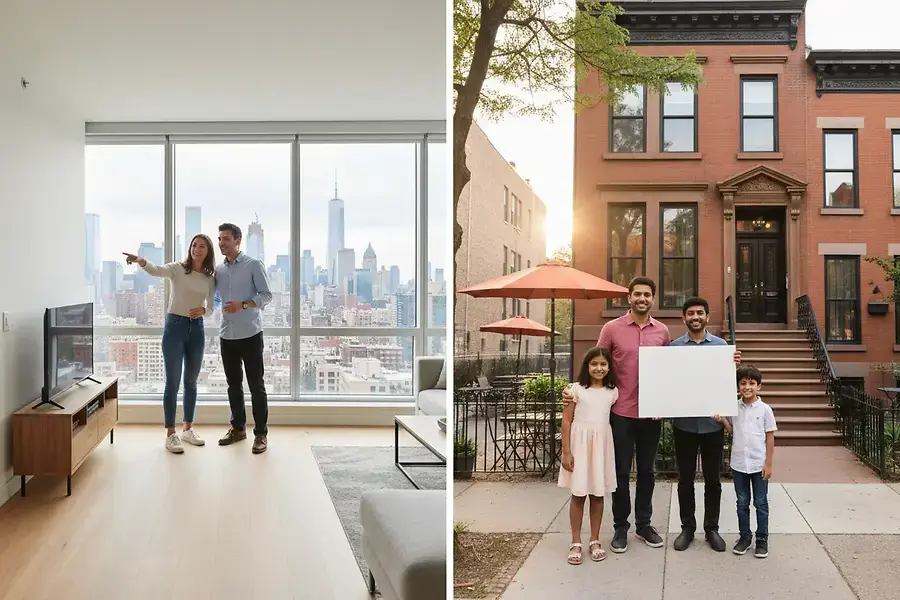
The Renting vs. Buying Decision in Today's NYC Market
The question of whether to rent or buy in New York City has never been more complex. With housing costs continuing to rise across all five boroughs, many New Yorkers are looking beyond Manhattan to the outer boroughs—Queens, Brooklyn, the Bronx, and Staten Island—where more affordable options exist. However, affordability alone doesn't determine the best choice for your situation. This financial analysis examines both sides of the equation to help you make an informed decision that aligns with your goals and lifestyle.
The outer boroughs have transformed dramatically over the past decade, offering vibrant neighborhoods, diverse communities, and significantly lower price points than their Manhattan counterparts. Yet the decision between renting and buying extends far beyond comparing monthly payments. It involves understanding your financial capacity, long-term plans, lifestyle preferences, and risk tolerance.
Financial Comparison: Monthly Costs, Down Payments, and Long-Term Equity Building
The Monthly Cost Breakdown
When comparing rents to mortgage payments, the numbers initially appear favorable to renters. A typical two-bedroom apartment in Queens might rent for $2,200 to $2,800 per month, while a comparable purchase in the same area could require a mortgage payment of $2,500 to $3,200 monthly. However, this surface-level comparison misses critical details.
Renters should budget for:
- Base rent payments
- Renter's insurance ($15-30/month)
- Utilities not included in rent
- Potential annual rent increases (typically 3-5%)
Homeowners must account for:
- Mortgage principal and interest
- Property taxes (varies significantly by borough)
- Homeowners insurance
- Maintenance and repairs (typically 1% of home value annually)
- HOA fees (if applicable)
- Utilities
The Down Payment Reality
One of the largest barriers to homeownership is the down payment. In Brooklyn's popular neighborhoods, down payments on a $600,000 condo might require $120,000 to $180,000 upfront. Even in more affordable areas of Queens, expect to save $80,000 to $120,000 for a 20% down payment on a $400,000 property.
This substantial initial investment is money renters don't need to deploy immediately. However, renters are building no equity—every dollar spent on rent is gone forever. Homeowners, conversely, build equity with each mortgage payment, creating a tangible asset that can appreciate over time.
Long-Term Equity and Wealth Building
The true advantage of homeownership emerges over time. Consider a homeowner who purchases a $450,000 property in Queens with a 20% down payment and a 30-year mortgage at current rates. After 10 years, assuming modest 2% annual appreciation, the property could be worth approximately $550,000, while the mortgage balance might be around $350,000. That's $200,000 in equity—wealth that didn't exist for a renter paying similar monthly costs.
Real estate appreciation in NYC's outer boroughs has historically averaged 2-3% annually, though past performance doesn't guarantee future results.
Renters, meanwhile, accumulate no equity. However, they maintain flexibility and liquidity—their savings aren't locked into a property.
Lifestyle and Flexibility Factors: When Each Option Works Best for Different Buyers
Renting Makes Sense If You:
- Plan to relocate within 5 years: Selling a home involves significant transaction costs (6-10% of sale price), making short-term ownership expensive.
- Value flexibility and minimal commitment: Leases typically last 12 months, allowing you to explore different neighborhoods or cities.
- Prefer predictable monthly expenses: Beyond rent increases, you're not surprised by major repair costs.
- Haven't accumulated substantial savings: Renting requires no down payment, allowing you to build emergency funds.
- Enjoy urban exploration: Renting lets you experience different neighborhoods before committing to one.
Buying Makes Sense If You:
- Plan to stay for 7+ years: This timeline allows appreciation and mortgage paydown to offset transaction costs.
- Want to build long-term wealth: Homeownership creates forced savings through mortgage payments and potential appreciation.
- Have stable income and employment: Mortgage lenders require proof of financial stability.
- Can afford a down payment and closing costs: Typically 3-5% in closing costs on top of your down payment.
- Desire control over your living space: Homeowners can renovate, decorate, and modify their properties freely.
- Want to lock in housing costs: With a fixed-rate mortgage, your principal and interest payment never increases.
The Neighborhood Factor
Different outer borough neighborhoods present different opportunities. Rapidly developing areas in Long Island City, Astoria, and Sunset Park may offer stronger appreciation potential but come with higher prices. More established, quieter neighborhoods in Forest Hills, Bay Ridge, or Bayside might appreciate more slowly but offer better affordability and stability.
Renters can test neighborhoods before committing. Buyers should research neighborhood trends, school quality, transportation access, and future development plans before purchasing.
Making Your Personal Decision with Confidence
The renting versus buying decision isn't purely financial—it's deeply personal. Consider these final factors:
Your Financial Health: Do you have an emergency fund, manageable debt, and the ability to save for a down payment? Can you afford a mortgage if interest rates rise or your income decreases?
Your Life Stage: Are you establishing your career, starting a family, or planning retirement? Your answer influences how long you'll stay in one place.
Your Risk Tolerance: Real estate values fluctuate. Are you comfortable with the possibility that your home's value might decrease in the short term?
Your Lifestyle Preferences: Do you crave stability and roots, or do you thrive on change and flexibility?
The outer boroughs offer compelling opportunities for both renters and buyers. Renters enjoy flexibility, lower barriers to entry, and the freedom to explore. Buyers build wealth, lock in housing costs, and create a foundation for long-term financial security.
Neither choice is universally "right." The best decision is the one that aligns with your financial situation, life goals, and personal values. Take time to analyze your specific circumstances, consult with financial advisors and real estate professionals, and choose the path that brings you confidence and peace of mind in your New York City home.